
Blown-In Insulation in North Hollywood, CA
Energy-Saving Blown-In Insulation in North Hollywood, CA for North Hollywood, CA Homes — Licensed & Insured
Expert blown-in insulation in North Hollywood, CA. NoHo Insulation Pros installs R-38+ attic insulation to cut energy bills. Free estimate — call 818-477-1218.
- Licensed & Insured
- Locally Owned & Operated
- Free Inspection & Estimate
Request Your
Free EstimateBlown-in insulation is a high-performance insulation method that uses specialized equipment to propel loose-fill material — typically cellulose or fiberglass — into attic spaces, wall cavities, and crawl spaces, creating a seamless thermal and acoustic barrier. Unlike batt insulation, blown-in material conforms to every gap, joist bay, and irregular surface, eliminating the air pockets that drive up energy bills.
In North Hollywood, CA — where summer temperatures routinely climb above 100°F in the San Fernando Valley and utility costs are among the highest in Los Angeles County — proper blown-in insulation is not a luxury. It is a practical necessity. At NoHo Insulation Pros, we are a professional insulation contractor dedicated exclusively to serving the North Hollywood community. Our crews understand the specific building stock, climate challenges, and local code requirements that make our market unique. Call us today at 818-477-1218 for a free on-site estimate.
Understanding Blown-In Insulation
What Is Blown-In Insulation?
Blown-in insulation — also called loose-fill insulation — is installed by feeding raw insulating material through a large-diameter hose connected to a blowing machine. A trained technician guides the hose across the surface to be insulated while a second crew member feeds bags of material into the hopper. The result is a uniform, monolithic layer that fills the target area to a precise, measured depth corresponding to the desired R-value.
A Brief Historical Context
Loose-fill insulation dates to the early twentieth century, when contractors used sawdust, cork, and mineral wool to reduce heat transfer in commercial buildings. By the 1970s energy crisis, blown-in cellulose — made from recycled newspaper treated with borate fire retardants — emerged as a cost-effective residential solution. Federal and California energy codes subsequently mandated increasingly higher R-values, and blown-in technology evolved to meet those standards efficiently.
Prevalence in the San Fernando Valley
North Hollywood sits squarely within the San Fernando Valley, a geographic basin that acts as a heat sink during summer. The Valley’s building stock spans multiple eras: post-World War II tract homes from the late 1940s and 1950s in neighborhoods like Valley Village and Lankershim, mid-century apartment complexes from the 1960s and 1970s, and newer infill construction from the 2000s onward. Each era presents distinct insulation challenges.
Many of the valley’s older homes were constructed with little to no insulation — or with degraded insulation that no longer meets California’s Title 24 energy standards. The California Energy Commission now requires a minimum R-38 in attics for climate zone 9, which covers most of Los Angeles County including North Hollywood. Blown-in insulation is the most practical way to achieve that rating in existing homes without a full renovation.
Building Types Most Suited to Blown-In Insulation
Blown-in insulation excels in: single-family homes with open attic access, multi-family apartment buildings where unit-to-unit noise transfer is a concern, older bungalows with irregular joist spacing, and commercial buildings with hard-to-reach roof decks. In North Hollywood, the most common application is attic top-up — adding blown-in material over existing old batts to bring total R-value up to current code.
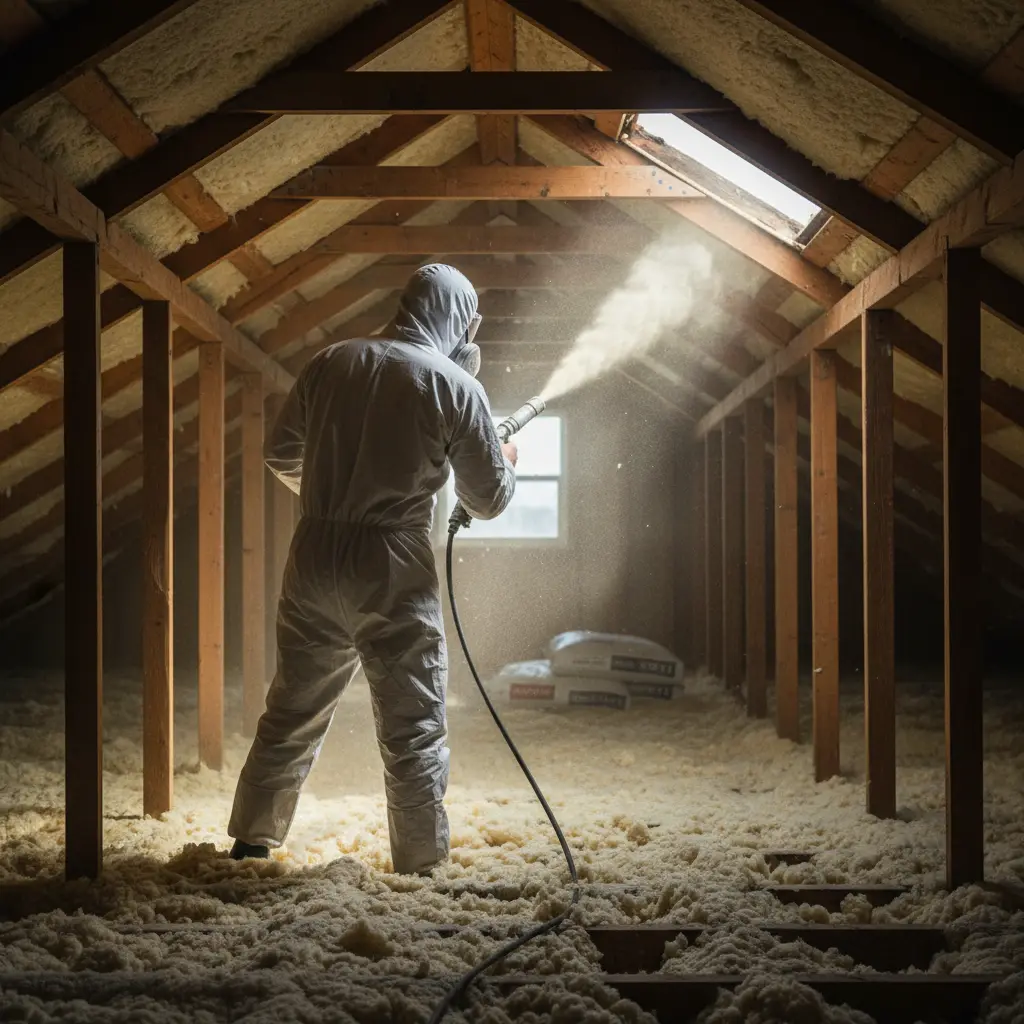
Our team in action — insulation professionals serving North Hollywood
Why Blown-In Insulation Is Needed in North Hollywood, CA
The San Fernando Valley Heat Island Effect
North Hollywood is located within the San Fernando Valley basin at an elevation of approximately 801 feet above sea level. The surrounding Santa Monica Mountains to the south, the Santa Susana Mountains to the northwest, and the Verdugo Mountains to the east trap hot air during summer inversion events. The National Weather Service recorded a temperature of 108°F at the Van Nuys Airport weather station — less than three miles from central North Hollywood — during the historic September 2022 heat event that broke records across Southern California. On average, North Hollywood experiences 73 days per year above 90°F, compared to just 12 days per year at the coast in Santa Monica.
This extreme thermal load means that an uninsulated or under-insulated attic can reach internal temperatures of 150°F to 160°F on a hot summer afternoon, radiating heat directly into living spaces below and forcing HVAC systems to run continuously — often adding $150 to $300 per month to summer utility bills for a typical 1,500-square-foot home.
Aging Building Stock and Deteriorated Insulation
The Lankershim Boulevard corridor and the residential streets surrounding the NoHo Arts District are home to thousands of homes built between 1945 and 1965. These properties were constructed under building codes that either did not require attic insulation or permitted as little as R-11. Fiberglass batts from that era have long since settled, compressed, or absorbed moisture from decades of condensation cycles, reducing their effective R-value by 30% to 50%. Blown-in cellulose can be installed directly over degraded batts, instantly restoring and surpassing the original thermal performance without requiring tear-out of old material.
Seismic Activity and Structural Settling
North Hollywood sits approximately 3.2 miles from the epicenter of the January 17, 1994 Northridge earthquake (magnitude 6.7), one of the most destructive seismic events in California history. Ground shaking from that event — and from the numerous smaller earthquakes along the Northridge and Hollywood fault systems since — causes wall framing to shift and insulation batts to displace from their cavities. Blown-in insulation, by contrast, has no rigid form to dislodge; it settles into a stable mass that remains effective even after moderate seismic movement.
Local Air Quality and Pest Pressure
The South Coast Air Quality Management District (SCAQMD) designates the San Fernando Valley as a non-attainment zone for particulate matter and ozone. Degraded insulation with gaps allows outdoor particulates to infiltrate living spaces. Additionally, North Hollywood’s urban tree canopy — particularly the mature ficus and palm trees common along Magnolia Boulevard and Tujunga Avenue — creates harborage conditions for roof rats (Rattus rattus) and squirrels that nest in attic insulation, contaminating and compressing it. Our blown-in insulation service pairs with rodent proofing and attic cleaning to address both the pest issue and the insulation deficiency simultaneously.
Rising Utility Rates
Southern California Edison (SCE), the primary electricity provider for North Hollywood residents, implemented rate increases averaging 5.8% annually between 2020 and 2024. Proper R-38 blown-in attic insulation can reduce cooling and heating energy consumption by 20% to 40% in a typical North Hollywood home, delivering a return on investment within three to five years depending on home size and current insulation state.
Signs You Need Blown-In Insulation in North Hollywood
Energy and Comfort Indicators
- Monthly SCE bills exceeding $200 during June through September for a home under 2,000 square feet
- HVAC system running more than 15 minutes per cycle during afternoon peak heat
- Second-floor or ceiling-adjacent rooms consistently 5°F or more warmer than the thermostat setting
- Drafts noticeable near recessed lights, electrical outlets on exterior walls, or attic hatch covers
Visual and Physical Symptoms
- Attic insulation depth below 10 inches (indicating R-value under R-30, well below the R-38 minimum required by California Title 24 for climate zone 9)
- Visible gaps, compressed zones, or missing sections in existing batt insulation
- Yellow or brown discoloration on batts indicating moisture absorption
- Rodent droppings, nesting material, or urine staining in attic insulation
- Ice dams are rare in North Hollywood, but efflorescence on drywall ceilings can indicate condensation from inadequate thermal separation
Urgency Indicators
- Your home was built before 1978 and has never had insulation upgraded — act before the next San Fernando Valley summer heat season
- HVAC equipment showing early failure signs such as frozen coils or short-cycling — inadequate insulation is often the root cause
- Recent rodent activity confirmed by a pest inspector — contaminated insulation must be removed and replaced promptly
Blown-In Insulation Methods and Approaches
Cellulose Blown-In Insulation
Recycled cellulose (75% to 85% post-consumer recycled paper) is the most common material we use in North Hollywood attics. It offers an R-value of approximately R-3.5 per inch, meaning a 10.5-inch layer achieves R-38. Cellulose is treated with borate compounds that resist fire and deter insects — a meaningful benefit in a region with a year-round pest season. It is also the most environmentally friendly option and qualifies for SCE rebates when installed to Title 24 standards.
Fiberglass Blown-In Insulation
Blown-in fiberglass provides R-2.2 to R-2.7 per inch and is preferred in locations with high moisture exposure, such as crawl spaces or attics adjacent to bathroom exhaust fans that lack proper termination to the exterior. Fiberglass does not absorb moisture and will not promote mold growth — a consideration in the older bungalows near the NoHo Arts District where original bathroom ventilation is often inadequate. Learn more about our fiberglass insulation service options.
Dense-Pack Blown-In for Wall Cavities
Many North Hollywood homes built before 1960 have uninsulated exterior wall cavities. Dense-pack installation involves drilling small access holes — typically 2 inches in diameter — through the exterior sheathing or interior drywall, inserting a fill tube, and blowing material under pressure until the cavity is completely packed. Dense-pack cellulose achieves R-3.7 per inch and effectively eliminates wall air infiltration.
Attic Top-Up Over Existing Insulation
When existing insulation is structurally sound and free of contamination, blown-in material can be added directly on top to bring depth and R-value up to current code minimums. This is the most cost-effective approach for homeowners in North Hollywood’s Valley Village and Toluca Lake neighborhoods who have original 1950s fiberglass batts in good condition. See our full attic insulation service page for details on top-up projects.
Ready for Blown-In Insulation? Get Your Free Estimate Today.
NoHo Insulation Pros serves North Hollywood and the surrounding area — we’ll be on-site within 24 hours.
📞 Call 818-477-1218Blown-In Insulation Cost in North Hollywood, CA
Typical Price Ranges
The cost of blown-in insulation in North Hollywood generally falls within the following ranges, based on current labor and material rates in the Los Angeles metro area:
- Attic blown-in insulation (cellulose, R-38 top-up): $1.00 to $1.75 per square foot installed, or approximately $1,200 to $2,600 for a 1,500-square-foot single-story home
- Attic blown-in insulation (fiberglass, R-38): $1.25 to $2.00 per square foot, or approximately $1,875 to $3,000 for the same footprint
- Dense-pack wall cavity insulation: $2.50 to $5.00 per square foot of wall area treated, depending on access method
- Combined attic removal and re-insulation: $2.50 to $4.50 per square foot when insulation removal is required prior to installation
Factors That Affect Your North Hollywood Project Cost
- Attic access difficulty: Low-pitch rooflines common in 1950s ranch homes in Toluca Lake can add $150 to $400 in labor due to restricted movement
- Existing insulation condition: Rodent-contaminated insulation must be removed under respiratory protection protocols, increasing prep costs
- Air sealing scope: Homes with many recessed lights (common in 1980s remodels) require more extensive pre-sealing work
- Material type and R-value target: Achieving R-49 (recommended for new construction in climate zone 9) costs more than the code-minimum R-38
Available Rebates and Incentives
Southern California Edison’s Residential Energy Efficiency Rebate program currently offers up to $0.10 per square foot for qualifying blown-in attic insulation projects. The federal Inflation Reduction Act’s 25C tax credit provides 30% of insulation project costs up to $1,200 per year. Contact us at 818-477-1218 for help identifying all rebates applicable to your property.
Neighborhoods We Serve in North Hollywood
NoHo Arts District
The NoHo Arts District’s dense concentration of 1920s and 1930s bungalows and converted commercial buildings presents complex insulation challenges, including irregular rafter spacing and original plaster walls that complicate dense-pack access. We have extensive experience navigating these older structures.
Valley Village
Bordering Laurel Canyon Boulevard, Valley Village’s mid-century tract homes from the 1950s are prime candidates for attic top-up projects. Original R-11 batts are still present in many of these homes, leaving significant thermal performance on the table.
Toluca Lake
Toluca Lake’s upscale ranch and modern homes — many renovated with open ceiling concepts — require careful coordination with HVAC ductwork located in attic spaces. Our technicians are experienced in working around existing mechanical systems without disturbing duct connections or electrical runs.
Lankershim / South North Hollywood
The apartment complexes and duplexes lining Lankershim Boulevard benefit from blown-in insulation for both thermal performance and sound transmission reduction between units — a priority for tenants and property managers alike.
Blown-In Insulation Maintenance Tips for North Hollywood Homeowners
- Inspect attic depth annually each October — before the mild North Hollywood winter — using the installed depth rulers. If average depth has dropped more than one inch, call for a top-up assessment.
- Check attic ventilation every spring. Blocked soffit vents force heat and moisture into the insulation layer. Clear debris — particularly from the large ficus and jacaranda trees common in North Hollywood — from roof vents after Santa Ana wind events.
- Seal attic access hatches. An unsealed attic hatch is equivalent to a 10-square-inch hole in your ceiling. Use weatherstripping and an insulated cover rated to at least R-30.
- Terminate bathroom and kitchen exhaust fans to the exterior, not into the attic. Moisture dumped into blown-in cellulose can reduce its R-value and promote mold.
- Schedule professional pest inspections annually. Roof rats are active year-round in the San Fernando Valley. Early detection prevents insulation contamination requiring full removal.
- Do not store items on top of blown-in insulation. Compressing the material even slightly permanently reduces its R-value. Install walkboards on raised cleats if attic storage is necessary.
- After any seismic event above magnitude 4.0, have a technician verify that insulation in knee walls and wall cavities has not displaced.
Why Choose NoHo Insulation Pros for Blown-In Insulation in North Hollywood
NoHo Insulation Pros is a professional insulation contractor built specifically to serve the North Hollywood and broader San Fernando Valley market. We are not a national franchise — we are your neighbors, familiar with the Northridge fault, the SCE utility rebate process, the Los Angeles Department of Building and Safety permit requirements, and the specific building stock challenges of every neighborhood from the NoHo Arts District to Toluca Lake.
Our full-service capabilities mean we can handle every component of your project under one roof: attic cleaning, rodent proofing, insulation removal, spray foam insulation, and crawl space insulation — in addition to blown-in installation. This integrated approach eliminates the need to coordinate multiple contractors and ensures that every step of your project is completed to a single, consistent quality standard.
We provide transparent, itemized written estimates before any work begins. We stand behind every installation and will return to address any performance concerns. Call us at 818-477-1218 to speak directly with a North Hollywood insulation expert.
Frequently Asked Questions — Blown-In Insulation in North Hollywood, CA
How much does blown-in insulation cost in North Hollywood?
A typical single-story North Hollywood home of 1,200 to 1,800 square feet costs between $1,200 and $2,800 for a full attic blown-in insulation project to R-38, including air sealing. Larger homes, two-story attics, and projects requiring prior insulation removal will cost more. Call 818-477-1218 for a free on-site estimate specific to your property.
How long does a blown-in insulation installation take in North Hollywood?
Most standard attic blown-in projects in North Hollywood are completed in a single day — typically four to eight hours including air sealing, installation, and cleanup. Dense-pack wall cavity projects may take one to two additional days depending on the number of walls treated.
Do I need to remove my existing insulation before adding blown-in?
Not always. If existing insulation is free of moisture damage, mold, or rodent contamination, blown-in material can be added directly on top — this is called a top-up and is the most cost-effective approach. However, if our inspection reveals pest activity, moisture damage, or heavily compressed old batts, we will recommend full insulation removal first to ensure the new material performs as intended.
What R-value is required for attic insulation in North Hollywood?
North Hollywood falls within California’s climate zone 9. The California Energy Commission’s Title 24 standards require a minimum of R-38 in attics for existing residential construction and R-49 for new construction. We recommend R-49 even for retrofit projects in North Hollywood given the extreme summer heat load of the San Fernando Valley basin.
Will blown-in insulation reduce noise from my neighbors or street traffic?
Yes. Blown-in cellulose has excellent sound absorption properties, reducing airborne noise transmission. This is particularly beneficial for North Hollywood residents near the Hollywood Burbank Airport flight path or along high-traffic corridors like Lankershim Boulevard and Vineland Avenue. Dense-pack wall insulation provides additional sound attenuation between units in multi-family buildings.
Is blown-in insulation safe for my family and pets?
Yes. Both cellulose and fiberglass blown-in insulation are inert once installed and present no ongoing health risk to occupants. During installation, our crew wears respiratory protection and we recommend you vacate the attic access area. The home is fully re-occupiable immediately after installation is complete and any installation dust has settled — typically within one to two hours.
Can I qualify for a rebate through Southern California Edison?
Many North Hollywood homeowners qualify for SCE’s Residential Energy Efficiency Rebate program when upgrading attic insulation to R-38 or higher. Additionally, the federal 25C energy-efficiency tax credit provides 30% of project costs up to $1,200 annually. We will provide all documentation you need to file for both incentives.
Do I need a permit for blown-in insulation in North Hollywood?
In most cases, adding blown-in insulation to an existing attic does not require a permit from the Los Angeles Department of Building and Safety (LADBS). However, if your project involves structural alterations, electrical work, or changes to mechanical systems, permits may be required. We will advise you during your assessment if a permit is necessary for your specific project.
Get Your Free Blown-In Insulation Estimate in North Hollywood Today
Summer heat in the San Fernando Valley is not going away — but your high utility bills can be significantly reduced. Whether your North Hollywood home needs a simple attic top-up, a complete insulation replacement after rodent damage, or dense-pack wall insulation to eliminate drafts, NoHo Insulation Pros has the expertise, equipment, and local knowledge to get the job done right.
Call us now at 818-477-1218 to schedule your free, no-obligation on-site assessment. Our team serves all of North Hollywood including the NoHo Arts District, Valley Village, Toluca Lake, and Lankershim. We offer flexible scheduling including Saturday appointments to accommodate working homeowners.
You can also explore our related services: attic insulation, spray foam insulation, and crawl space insulation. Do not wait until the next heat wave to protect your home and your budget. Contact NoHo Insulation Pros today.