
Roof Insulation in North Hollywood, CA
Expert Roof Insulation in North Hollywood, CA — Storm-Tested, Warranty-Backed
Expert roof insulation in North Hollywood, CA. Spray foam, blown-in & attic systems for Valley heat. Title 24 compliant. Call (818) 477-1218 for a free assessment.
- Licensed & Insured
- Locally Owned & Operated
- Free Inspection & Estimate
Request Your
Free EstimateRoof insulation is the process of installing thermal and acoustic barrier materials between your roofing structure and living spaces to regulate indoor temperatures, reduce energy consumption, and protect your home from the extreme heat that defines San Fernando Valley summers. In North Hollywood, where rooftop temperatures routinely exceed 160°F on exposed surfaces during July and August, proper roof insulation is not a luxury — it is a necessity for comfort, cost control, and structural longevity.
At NoHo Insulation Pros, we specialize in diagnosing and resolving insulation failures specific to North Hollywood’s climate, housing stock, and building codes. From the mid-century bungalows along Magnolia Boulevard to the newer mixed-use developments rising near the NoHo Arts District, our team delivers tailored roof insulation solutions that perform under Southern California’s demanding conditions. Call us today at (818) 477-1218 to schedule your assessment.
Understanding Roof Insulation in North Hollywood, CA
Roof insulation refers to any material system installed at the roof deck, rafter cavity, or attic floor level that resists the transfer of heat between the exterior roofing surface and the conditioned interior of a building. The science behind it is straightforward: materials with higher R-values slow the rate at which thermal energy moves through a building assembly, keeping interiors cooler in summer and warmer in winter.
Historically, homes built in North Hollywood during the post-World War II construction boom of the 1940s and 1950s — when the neighborhood expanded rapidly to house returning veterans and their families — were built with little to no roof insulation. Building codes of that era did not mandate insulation minimums, and the materials available were far less effective than modern spray foam, blown cellulose, or rigid foam board systems. Many of these original structures still stand today, particularly in the residential corridors near Lankershim Boulevard and Tujunga Avenue, and their insulation systems are either nonexistent or severely degraded.
California’s Title 24 Building Energy Efficiency Standards, which have grown increasingly stringent with each code cycle, now require minimum R-38 insulation in attic and roof assemblies for Climate Zone 9, which encompasses North Hollywood. Meeting and exceeding this threshold is essential not only for code compliance during renovations but for achieving meaningful energy savings in a city where air conditioning accounts for a disproportionately large share of residential utility bills.
North Hollywood’s building inventory spans a wide range of construction types, each presenting unique insulation challenges. You will find single-story ranch homes with vented attic spaces, two-story Spanish Colonial Revival structures with low-slope tile roofs, flat-roof apartment buildings constructed in the 1960s and 1970s, and modern townhomes with complex roof geometries. Each building type requires a different insulation strategy, and understanding the nuances of local construction is central to delivering a system that performs correctly over its intended lifespan.
Roof insulation works in combination with attic ventilation, air sealing, and radiant barriers to create a complete thermal envelope. Learn more about our attic insulation services to understand how these systems interact and reinforce one another in North Hollywood homes.
Why Roof Insulation Is Needed in North Hollywood, CA
North Hollywood occupies the eastern portion of the San Fernando Valley floor, a broad inland basin surrounded on three sides by mountain ranges — the Santa Monica Mountains to the south, the Santa Susana Mountains to the northwest, and the San Gabriel Mountains to the northeast. This geography creates a heat-trapping bowl effect that makes North Hollywood measurably hotter than coastal Los Angeles communities just 12 miles away.
The National Weather Service station at Burbank Airport, the closest official monitoring station to North Hollywood, regularly records summer high temperatures between 95°F and 108°F during heat events. The extreme heat wave of September 2022 pushed recorded temperatures in the eastern San Fernando Valley to 111°F, directly exposing the vulnerability of homes with inadequate roof insulation. During that event, utility providers recorded demand spikes that led to rolling stress advisories across LADWP’s service grid, which includes all of North Hollywood.
The urban heat island effect compounds the problem locally. North Hollywood’s commercial corridors along Lankershim, Vineland Avenue, and Cahuenga Boulevard are heavily paved and developed, absorbing solar radiation and re-radiating it as heat well into the evening hours. Studies by UCLA’s Institute of the Environment estimate that urban heat island conditions can add 4°F to 8°F to ambient temperatures in densely developed San Fernando Valley corridors compared to adjacent undeveloped areas. For a home with failing or absent roof insulation, this means the thermal load that insulation must resist is even greater than the already extreme base climate would suggest.
Santa Ana wind events, which typically occur between October and February, introduce a secondary roof insulation concern: rapid temperature fluctuation. When offshore winds push warm, dry air into the Valley from the northeast, temperatures can spike 20°F to 30°F within a matter of hours, then plunge equally quickly when the event ends. These thermal cycles stress roofing materials and any insulation systems that are not properly air-sealed, causing repeated expansion and contraction that degrades adhesion, compresses batt insulation, and introduces air infiltration pathways over time.
Fire risk is another location-specific factor. The Woolsey Fire of November 2018 and the Creek Fire of September 2020, while centered in adjacent jurisdictions, blanketed North Hollywood neighborhoods including Valley Village and Studio City-adjacent areas with heavy smoke and ash for days at a time. Homes with compromised roof insulation and inadequate air sealing allowed smoke particulates to infiltrate living spaces more readily, degrading indoor air quality. Properly installed spray foam or sealed blown-in insulation significantly reduces this infiltration pathway.
Finally, North Hollywood’s older housing stock presents a specific moisture management challenge despite the arid climate. Many flat-roof apartment buildings constructed between 1955 and 1975 — clustered heavily in the Noho West and Arts District adjacent blocks — have failed roofing membranes that permit seasonal moisture intrusion during the November-through-March rainy period. When moisture reaches degraded fiberglass batt insulation in these assemblies, R-value can be reduced by 30% to 50%, and mold colonization becomes a serious risk within the enclosed roof cavity.
Signs You Need Roof Insulation in North Hollywood
Temperature and Comfort Indicators
- Rooms on the top floor or directly beneath the roofline are consistently 8°F to 15°F hotter than the rest of the home during summer afternoons
- Your air conditioning system runs continuously during Valley heat events without achieving the thermostat set point
- Noticeable drafts or cold spots along ceiling lines during winter nights when temperatures dip into the 40s°F
- Radiant heat felt when standing near the ceiling of upper-floor rooms in summer
Energy and Cost Indicators
- LADWP bills spike dramatically between June and September compared to spring and fall baseline usage
- Year-over-year utility costs increasing without a corresponding change in occupancy or usage habits
- HVAC system cycling on and off more frequently than it did in prior years
Physical and Structural Indicators
- Visible gaps, sagging, or compressed insulation batts observable through attic access hatches
- Water stains on ceiling drywall following winter rains, indicating moisture has reached the insulation layer
- Musty or stale odors emanating from attic spaces, suggesting mold growth in wet insulation
- Insulation material that appears discolored, flattened, or contaminated with rodent activity
Urgency note: If you observe water staining combined with musty odors, treat this as an urgent situation. Wet insulation loses thermal performance rapidly and can support mold growth that spreads to structural framing within 24 to 72 hours of significant moisture exposure.
Our Roof Insulation Process in North Hollywood
Comprehensive Assessment (Day 1 — 1 to 2 Hours)
We begin with a detailed inspection of your existing roof assembly, attic space, and living areas. Using thermal imaging cameras, we map heat transfer patterns specific to your roof’s orientation — critical in North Hollywood, where south- and west-facing roof planes bear the greatest solar load during afternoon hours. We document current R-values, air sealing deficiencies, ventilation conditions, and any moisture damage.
Insulation Removal and Disposal (Day 1 or 2 — 2 to 6 Hours)
Where existing insulation is degraded, contaminated, or insufficient, we perform complete removal using negative-pressure vacuum equipment to prevent fiber and particulate contamination of living spaces. All removed material is bagged, sealed, and disposed of in compliance with California waste disposal regulations. This step is especially common in North Hollywood homes built before 1980.
Air Sealing and Prep (Day 2 — 2 to 4 Hours)
Before any new insulation is installed, we seal all penetrations, top plates, recessed lighting fixtures, and HVAC boot connections using two-component spray foam and mastic sealant. In North Hollywood’s climate, air sealing delivers as much energy benefit as the insulation itself by eliminating conditioned air loss through the roof assembly.
Insulation Installation (Day 2 or 3 — 3 to 8 Hours)
We install the specified insulation system — spray foam, blown-in, batt, or a hybrid combination — ensuring full coverage and target R-value achievement. For North Hollywood’s Climate Zone 9, we target a minimum of R-49 in vented attic assemblies to exceed current Title 24 requirements and provide margin for future code updates.
Ventilation Verification (Day 3 — 1 to 2 Hours)
Proper attic ventilation is essential to prevent heat buildup and moisture accumulation. We verify that soffit-to-ridge airflow paths are unobstructed and that ventilation rates meet California Building Code requirements of 1 square foot of net free ventilation area per 150 square feet of attic floor area.
Final Inspection and Documentation (Day 3 — 30 to 60 Minutes)
We conduct a post-installation thermal scan to confirm uniform coverage, provide written documentation of installed R-values for permit compliance and future real estate disclosures, and walk you through any ongoing maintenance recommendations specific to your roof type and North Hollywood’s climate conditions.
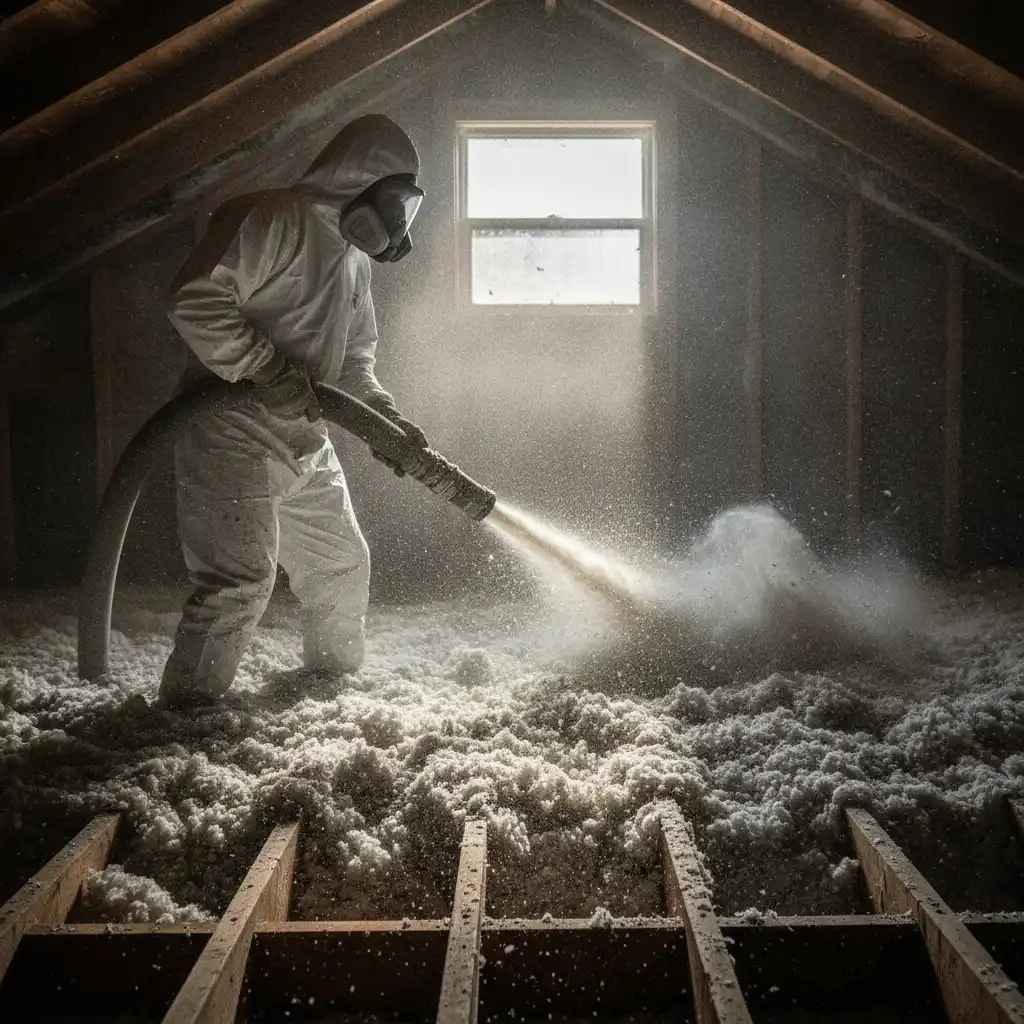
Our team in action — insulation professionals serving North Hollywood
Roof Insulation Methods and Approaches
Spray Foam Insulation
Two-component closed-cell spray polyurethane foam is the highest-performing option for North Hollywood roof assemblies. With an R-value of approximately R-6.5 per inch, closed-cell foam provides superior thermal resistance in thin profiles — ideal for low-slope roofs or shallow rafter cavities common in mid-century North Hollywood construction. It also functions as an air and vapor barrier, addressing Santa Ana wind infiltration and winter moisture concerns simultaneously. Explore our spray foam insulation services for detailed specifications.
Blown-In Insulation
Blown cellulose and blown fiberglass are highly effective in vented attic assemblies with accessible attic floors. Blown-in systems conform to irregular framing and around obstructions, making them well-suited to the complex ceiling geometries found in older North Hollywood Craftsman and Spanish bungalows. Cellulose, made from recycled paper treated with borate-based fire retardant, is particularly appropriate given Southern California’s fire risk profile. Learn about our blown-in insulation options.
Fiberglass Batt Insulation
Pre-cut fiberglass batts remain a cost-effective solution for new construction or open rafter bays with standard 16-inch or 24-inch on-center framing. In North Hollywood renovation projects where roof assemblies are partially opened for other work, batts allow efficient installation without the equipment overhead of spray or blown systems.
Hybrid Systems
Many North Hollywood homes benefit from a combination approach: a thin layer of closed-cell spray foam applied directly to the roof deck for air sealing and moisture control, topped with blown cellulose to achieve target R-values economically. This hybrid strategy balances performance with budget and is particularly effective in the flat-roof apartment buildings common in the 91601 and 91605 ZIP codes.
Ready for Roof Insulation? Get Your Free Estimate Today.
NoHo Insulation Pros serves North Hollywood and the surrounding area — we’ll be on-site within 24 hours.
📞 Call (818) 477-1218Roof Insulation Cost in North Hollywood, CA
Understanding roof insulation costs in North Hollywood requires accounting for several variables specific to the local market, building stock, and California’s regulatory environment.
Typical Price Ranges
- Blown-in attic insulation (cellulose or fiberglass): $1.50 to $3.00 per square foot installed, or $2,500 to $5,500 for a typical 1,500 to 2,000 square foot North Hollywood home
- Spray foam insulation (closed-cell): $4.50 to $7.00 per square foot installed, with whole-roof applications typically ranging from $6,000 to $14,000 depending on roof area and complexity
- Fiberglass batt replacement: $1.25 to $2.50 per square foot, or $1,800 to $4,500 for standard residential applications
- Insulation removal and disposal: $1.00 to $2.00 per square foot as a standalone service, typically $1,500 to $3,500 for full attic clearing
- Hybrid spray foam and blown-in systems: $3.00 to $5.00 per square foot, representing a middle-ground investment for maximum performance
North Hollywood Cost Factors
Several location-specific factors influence final pricing in North Hollywood. California’s prevailing wage and labor cost environment means installation costs run 15% to 25% higher than national averages. Los Angeles building permits for insulation work, required for projects exceeding certain scope thresholds, typically add $150 to $450 to project costs. Homes in North Hollywood’s historic residential corridors may require additional coordination with the LA Department of Building and Safety for projects touching older roof assemblies.
LADWP and Southern California Gas Company both offer rebate programs for qualifying insulation upgrades that can offset $300 to $1,500 of project cost. We help our customers identify and apply for applicable incentives as part of every project. Learn about our insulation removal and replacement services for cost details on full-system replacements.
Neighborhoods We Serve in North Hollywood
NoHo Arts District
The dense, walkable core of North Hollywood centered on Lankershim Boulevard features a heavy concentration of 1960s and 1970s apartment buildings with flat or low-slope roofs. These structures frequently suffer from failed roofing membranes and completely absent or severely degraded insulation systems. We specialize in flat-roof spray foam and hybrid insulation systems appropriate to this building type.
Valley Village
This predominantly residential neighborhood immediately south of Burbank Boulevard features a well-preserved stock of 1940s and 1950s single-family homes with vented attics. Many have original fiberglass batts that have compacted to a fraction of their rated R-value over 60-plus years. Blown-in cellulose upgrades are the most common solution here.
Toluca Lake Adjacent / Cahuenga Pass Corridor
Homes in this western North Hollywood corridor tend to be larger and built on hillside lots with complex roof geometries. Multiple roof planes, skylights, and cathedral ceiling sections require careful hybrid insulation planning. We have extensive experience navigating these architectural challenges.
North Hollywood Industrial Transition Zone (Vanowen Street Corridor)
This area includes mixed residential and light commercial properties with diverse construction eras ranging from 1940s bungalows to 2000s townhome infill. Multi-unit residential buildings in this zone frequently need both insulation replacement and comprehensive air sealing to address urban heat island impacts along the heavily paved commercial corridor.
Roof Insulation Maintenance Tips for North Hollywood Homeowners
- Inspect your attic access annually in October, before winter rains begin, looking for signs of moisture intrusion, pest activity, or displaced insulation that may have occurred during the hot, dry summer months.
- Check attic ventilation screens each spring for wasp nests, debris, and blockages that can impair the soffit-to-ridge airflow that keeps your insulation performing correctly through summer heat events.
- After significant Santa Ana wind events, inspect your roof for lifted or damaged roofing materials that could allow moisture to reach your insulation assembly during subsequent winter rains.
- Monitor your LADWP bills month-to-month. A sudden 20% or greater increase in summer cooling costs that is not explained by rate changes or occupancy often signals insulation degradation.
- Keep attic access hatches properly weather-stripped and insulated. Uninsulated attic hatches are one of the most common heat infiltration pathways in North Hollywood homes.
- Control roof penetrations. Each new HVAC, plumbing, or electrical penetration through your roof or ceiling assembly creates an air sealing gap. Have new penetrations sealed by a professional whenever rooftop equipment is serviced or replaced.
- Consider a radiant barrier in combination with insulation for west-facing roofs that absorb intense afternoon solar radiation during North Hollywood’s long summer season.
Why Choose NoHo Insulation Pros in North Hollywood
NoHo Insulation Pros is built around the specific needs of North Hollywood and San Fernando Valley homeowners and property managers. We are not a national franchise applying generic solutions — we are a locally focused team with deep familiarity with the 91601, 91602, 91605, and 91606 ZIP codes, the building types within them, and the climate realities that make roof insulation in this area uniquely demanding.
Our technicians are trained on California’s Title 24 compliance requirements and understand how insulation decisions interact with LADWP rebate eligibility, LA Department of Building and Safety permit requirements, and the specific roofing assemblies common to each neighborhood era of North Hollywood construction.
We offer comprehensive services that cover every stage of your insulation project: insulation removal, spray foam installation, attic insulation, blown-in insulation, and crawl space insulation and encapsulation. This means one contractor, one point of accountability, and a complete solution for your home’s thermal envelope.
Call us at (818) 477-1218 to speak directly with a North Hollywood insulation specialist.
Frequently Asked Questions About Roof Insulation in North Hollywood
How much does roof insulation cost in North Hollywood, CA?
Costs depend on your roof type, current insulation condition, and chosen material. For a typical 1,500 to 2,000 square foot North Hollywood home, blown-in attic insulation runs $2,500 to $5,500, while spray foam applications range from $6,000 to $14,000. LADWP rebates can reduce your out-of-pocket cost by $300 to $1,500 for qualifying projects. We provide detailed written estimates at no charge after our initial assessment.
What R-value do I need for my North Hollywood home?
California’s Title 24 standards for Climate Zone 9, which includes North Hollywood, require a minimum of R-38 in attic assemblies. We recommend targeting R-49 or higher to exceed current code, provide margin for future regulatory updates, and achieve meaningful comfort improvements given the Valley’s extreme summer heat load.
How long does roof insulation installation take in North Hollywood?
Most residential projects are completed in one to three days. A straightforward blown-in installation in a vented attic can be done in a single day. Projects requiring full removal of old insulation, comprehensive air sealing, and spray foam application in complex roof geometries typically take two to three days. We schedule projects to minimize disruption to your household.
Is a permit required for insulation work in North Hollywood?
In most cases, insulation replacement as part of a reroofing project or whole-house renovation requires a permit from the LA Department of Building and Safety. Standalone insulation upgrades may not require a permit depending on scope, but we always verify requirements for your specific project and handle permit coordination when needed.
Can roof insulation help with smoke infiltration during wildfire events near North Hollywood?
Yes. Properly air-sealed insulation systems — particularly spray foam applications — significantly reduce the infiltration of smoke and ash particulates through roof assemblies. This is a meaningful benefit for North Hollywood residents given the frequency of smoke events from fires in adjacent mountains and canyons. Air sealing during insulation installation is the key factor, not insulation depth alone.
How do I know if my existing insulation is still performing adequately?
Thermal comfort problems, rising utility bills, and visible degradation of attic insulation are the primary indicators. Our thermal imaging assessment provides an objective map of heat transfer patterns across your entire roof assembly, identifying performance gaps that are invisible to the naked eye. We offer this assessment as part of our standard consultation process.
Does NoHo Insulation Pros handle insulation removal for homes with old fiberglass batts?
Absolutely. Insulation removal is one of our core services. Learn about our complete insulation removal and replacement process. We remove degraded batts, blown-in material, or failing spray foam using vacuum extraction equipment, dispose of all material in compliance with California regulations, and prepare the space for a fresh, code-compliant installation.
What is the difference between attic insulation and roof insulation?
Attic insulation is typically installed at the attic floor level, insulating the ceiling of the living space below. Roof insulation is installed at the roof deck or rafter cavity level, creating an unvented or conditioned attic. The right approach depends on your roof type and HVAC configuration. Homes in North Hollywood with ductwork running through attic spaces often benefit from roof-deck spray foam that brings the duct system inside the conditioned envelope. Compare attic and roof insulation approaches on our attic insulation page.
Get Your Roof Insulation Assessment in North Hollywood Today
North Hollywood summers are not getting cooler, and energy costs are not going down. Every month without adequate roof insulation means higher utility bills, reduced comfort, and additional strain on your HVAC system. NoHo Insulation Pros is ready to assess your home, recommend the right solution for your roof type and budget, and complete the installation with minimal disruption to your schedule.
Call us now at (818) 477-1218 to speak with a North Hollywood roof insulation specialist and schedule your no-obligation thermal assessment. You can also reach out through our contact page for a written estimate. We serve all of North Hollywood and the surrounding San Fernando Valley communities and are ready to help you take control of your home’s energy performance before the next heat event arrives.